The Other Gender Gap

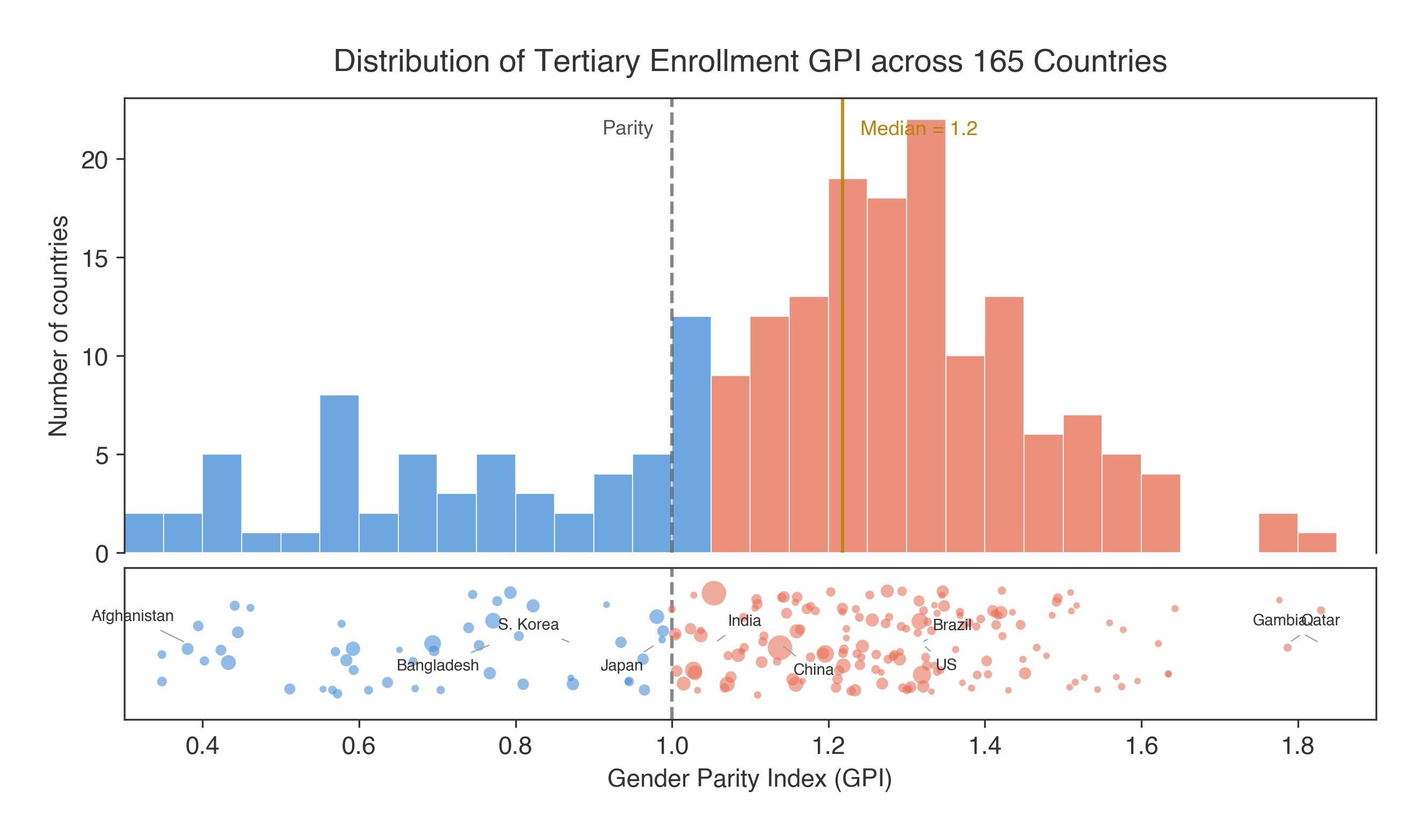
In 152 of 203 countries with available data, more women than men are enrolled in tertiary education. The median Gender Parity Index, the ratio of female to male gross enrollment, is 1.22. The interquartile range is [1.00, 1.35]. Only 51 countries remain below parity.
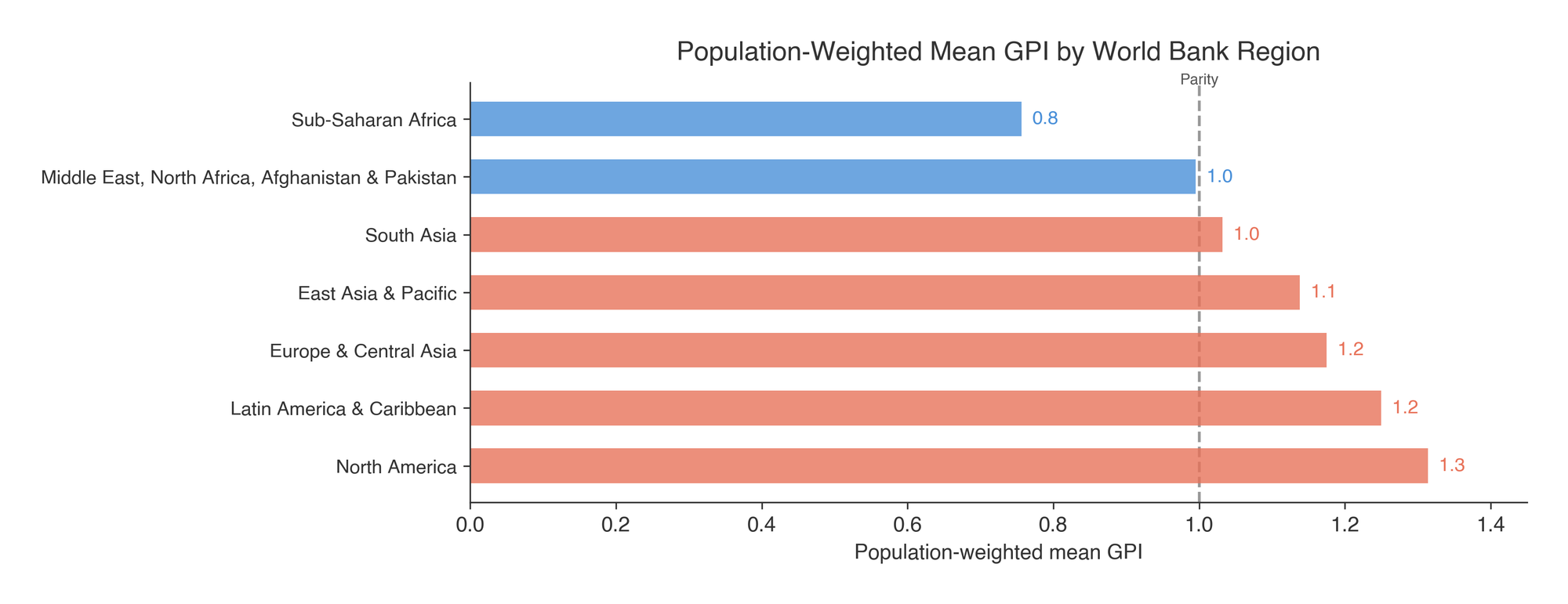
The population-weighted mean is lower at 1.06. Having said that, Sub-Saharan Africa is the only region with a population-weighted mean below 1. South Asia barely clears parity. Every other region is comfortably above it.
GPI follows a monotonic relationship with income. Low-income countries average a GPI of 0.67; lower-middle 1.01; upper-middle 1.17; high-income 1.20.
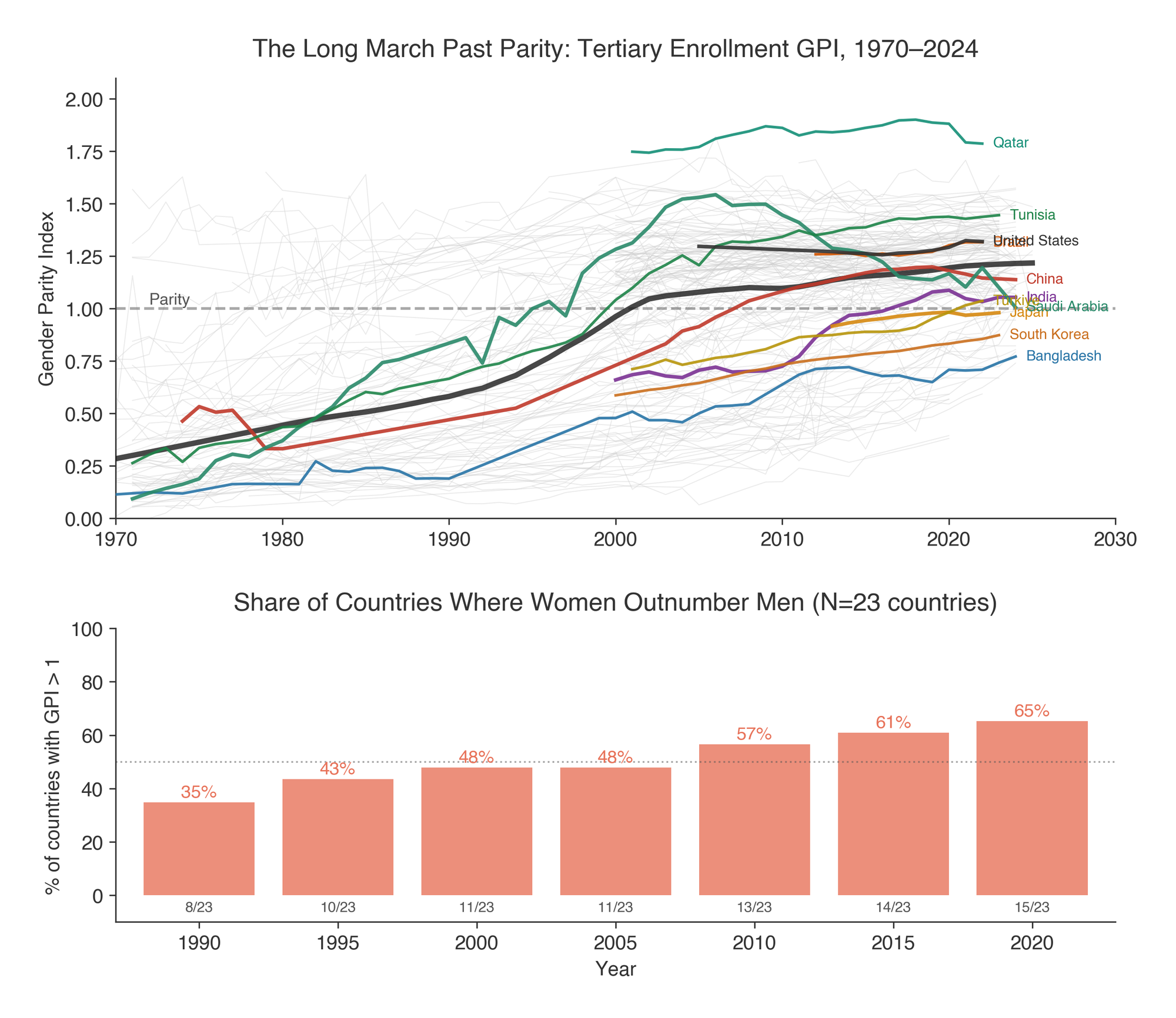
The cross-section doesn't tell us how quickly this has happened. In a balanced panel of 30 countries tracked since 1990, only a third had GPI above 1 in 1990. By 2000, nearly half. By 2024, two-thirds. Individual trajectories are more striking still. The United States crossed parity around 1980 and kept climbing to 1.32. China went from 0.37 in 1985 to 1.14 today. Saudi Arabia rose from 0.09 in 1970, nine women enrolled for every hundred men, to parity by the 2010s. Tunisia went from 0.46 to 1.45, one of the most dramatic reversals anywhere. The conspicuous holdouts among rich countries are Japan (0.98) and South Korea (0.87), where the gap is closing but slowly.
Code and data on GitHub.